CSE Associate Professor Emeritus Bill Rapaport won the 2015 Covey Award. The Covey Award recognizes senior scholars with a substantial record of innovative research in the field of computing and philosophy broadly conceived.
Assistant Professor Dimitrios Koutsonikolas and Li Sun (PhD Candidate '17) will present their paper titled "WiDraw: Enabling Handsfree Drawing in the Air on Commodity WiFi Devices" this September at the prestigious MobiCom 2015 in Paris, France.
Assistant Professor Oliver Kennedy and Ying Yang (PhD Candidate '17) will present their paper titled "Lenses: An On-Demand Approach to ETL" this September at the Very Large Databases (VLDB) conference 2015 on the Big Island of Hawai'i.
Venu Govindaraju, a globally recognized expert in machine learning and pattern recognition, has received the IAPR/ICDAR Outstanding Achievements Award.
Intrigued by an opportunity to use ‘big data’ to further societal development, Pokhriyal entered the 2015 Data for Development (D4D) Senegal Challenge and won the National Statistics Prize.
SUNY Distinguished Professor and UB Interim VP for Research and Economic Development Venu Govindaraju is part of an Office of the Director of National Intelligence/Intelligence Advanced Research Projects Activity (IARPA) consortium for the project titled, "Sparse Heterogeneous Representations and Domain Adaptive Matching for Unconstrained Face Recognition".
Mike Buckley thanks Kevin Lyman, Kate Truscott, and the entire Vans Warped Tour 2014 for their generous donation to The Center for Socially Relevant Computing. The gift will be used to purchase music, sight, and sound equipment (how appropriate!) for a system that teaches cause-and-effect and choice-making to autistic children using customizable sensory-intense feedback.
Ken Regan develops algorithms that detect cheating in chess games. His software compares a player's moves to a database of the player's typical gameplay, then makes an assessment of the statistical likelihood of cheating. Dr. Regan frequently consults at international chess matches.
An article on PhysOrg reports UB received a $584,469 grant from the National Science Foundation to create a tool designed to work with the existing computing infrastructure to boost data transfer speeds by more than 10 times, and quotes Tevfik Kosar, associate professor of computer science.
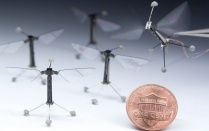
Karthik Dantu owns the vision component of the RoboBee Initiative, led by the National Science Foundation and Harvard University. The "eyes" that Dr. Dantu is integrating are laser-powered sensors that enable the mechanical bees to orient themselves in space.
Wenyao Xu leads an NSF-funded program that detects 3D printing data security vulnerabilities by using smart phones to analyze electromagnetic and acoustic waves. Kui Ren and Chi Zhou are co-authors.
Wenyao Xu created AutoDietary—software that tracks the unique sounds produced by food as people chew it. AutoDietary, placed near the throat by a necklace delivery system developed at China's Northeastern University, helps users measure their caloric intake.