Data and communication are critical pieces of many systems. For decades, computer science theorists worked to determine the best way to recover information when it gets corrupted in ways designed to make recovery difficult.
There are problems that exist when reviewing any large datasets. A paper — co-authored by a University at Buffalo researcher and written 10 years ago — was recognized for its impact in helping to solve these problems.
TechLearning.com published a story about UB’s new Department of AI and Society and quoted Atri Rudra, who noted that he wants to see the department become an incubator for AI that is built from the ground up with society in mind.
Inside Higher Education quoted Atri Rudra in a report on how four universities, including UB, are incorporating generative AI into learning environments.
The department will harness artificial intelligence for the public good, and build upon UB’s longstanding leadership in AI and its role as New York’s flagship university.
Wenyao Xu leads an NSF-funded program that detects 3D printing data security vulnerabilities by using smart phones to analyze electromagnetic and acoustic waves. Kui Ren and Chi Zhou are co-authors.
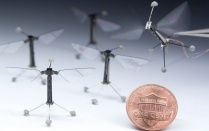
Karthik Dantu owns the vision component of the RoboBee Initiative, led by the National Science Foundation and Harvard University. The "eyes" that Dr. Dantu is integrating are laser-powered sensors that enable the mechanical bees to orient themselves in space.
Ken Regan develops algorithms that detect cheating in chess games. His software compares a player's moves to a database of the player's typical gameplay, then makes an assessment of the statistical likelihood of cheating. Dr. Regan frequently consults at international chess matches.
An article on PhysOrg reports UB received a $584,469 grant from the National Science Foundation to create a tool designed to work with the existing computing infrastructure to boost data transfer speeds by more than 10 times, and quotes Tevfik Kosar, associate professor of computer science.
Wenyao Xu created AutoDietary—software that tracks the unique sounds produced by food as people chew it. AutoDietary, placed near the throat by a necklace delivery system developed at China's Northeastern University, helps users measure their caloric intake.